Recreational vehicles occupy an unusual position in the transport market. They are large enough that moving one under its own power across the country is a legitimate option for many owners, yet the situations that make professional transport worth considering are common enough that the question comes up regularly. Seasonal repositioning, remote purchases, and mechanical breakdowns mid-trip all create scenarios where shipping makes more sense than driving.
The logistics for RVs and motorhomes differ meaningfully from standard vehicle transport, and understanding those differences before you start calling carriers saves time and prevents surprises.
Content
When Shipping an RV Makes Sense
The most straightforward case is a purchase. Private RV sales increasingly happen across provincial lines, driven by the same online marketplace dynamics that expanded the used car search nationally. When the right unit at the right price is in Regina and you are in Halifax, driving it home means a multi-day trip through unfamiliar territory in a large vehicle you have never operated before. For buyers without that experience, or without the time, shipping is the cleaner solution.
Seasonal repositioning is another common driver. Owners who store their RV in a different location than where they use it — a storage facility near the family cottage, a winter storage yard in a milder climate, or a dedicated RV storage park — may ship rather than drive when the seasonal move coincides with a period when they cannot make the trip themselves.
Breakdown recovery is less planned but equally real. An RV that develops a mechanical issue mid-trip, far from home and far from a qualified repair facility, sometimes needs to be transported rather than driven. Understanding that professional transport is available in these scenarios — and roughly what it involves — is worth knowing before you are standing on a highway shoulder in northern Ontario trying to figure out your options.
How RV Transport Differs from Standard Vehicle Shipping
The most significant difference is size. Class A motorhomes can exceed 12 metres in length and 4 metres in height. Class B and C units are smaller but still substantially larger than any passenger vehicle. That size affects everything from the equipment required to the permits needed to move the unit on public roads.
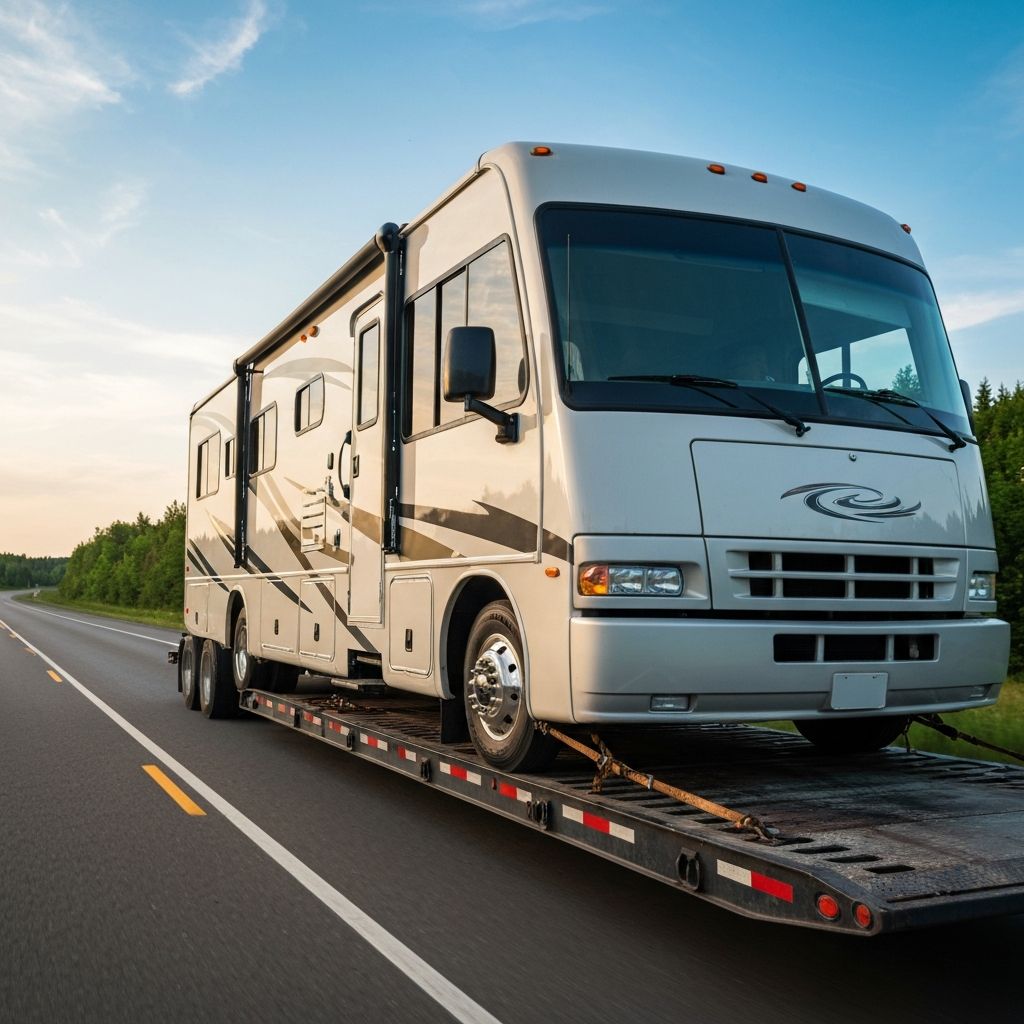
Standard auto transport carriers — the multi-car trailers you see on highways loaded with sedans and SUVs — are not the right equipment for most RVs. Motorhomes are typically transported using a drive-away service, a flatbed or lowboy trailer for non-running units, or in some cases a specialized RV transport carrier. The right method depends on the unit type, its mechanical condition, and whether it can be driven.
Drive-away service, where a professional driver operates the RV under its own power to the destination, is the most common method for roadworthy motorhomes. It is generally less expensive than flatbed transport and does not require specialized loading equipment. The trade-off is that it adds mileage to the unit and requires the driver to have appropriate licensing for the vehicle class.
Permits and Oversized Load Requirements
Large RVs — particularly Class A motorhomes and fifth-wheel trailers above certain dimensions — may qualify as oversized loads under provincial transport regulations. Oversized loads require permits from each province the vehicle passes through, and in some cases may require escort vehicles or be restricted to specific travel windows.
Carriers who regularly move RVs handle permit acquisition as part of the service. When evaluating carriers, confirm that permit management is included in their process and that they have experience with the specific dimensions of your unit. A carrier who primarily handles passenger vehicles and occasionally takes on an RV may not have the permit infrastructure that a dedicated RV transport operator does.
Dimensions matter precisely here. Height is often the critical variable — overhead clearance on Canadian highways varies, and a unit that clears most routes may still require routing adjustments for specific bridges or underpasses. Providing accurate height, length, and weight figures at the time of booking is not optional. RV and motorhome shipping requires this information to be accurate before a carrier can confirm the route and provide a reliable quote.
Preparing an RV for Transport
Preparation for RV transport is more involved than for a standard vehicle, primarily because the living space inside creates more variables than an empty passenger compartment.
All loose items inside the unit must be secured or removed. Dishes, small appliances, toiletries, and anything stored in overhead compartments will shift during transport. Items that are not secured can cause interior damage, and carriers are not responsible for personal property left inside. For a drive-away shipment, this preparation is especially important because the unit will be in motion for an extended period.
Fresh water tanks should be drained. A full fresh water tank adds hundreds of kilograms of unnecessary weight and creates sloshing forces during transit that stress the vehicle’s structure. Grey and black tanks should also be emptied and sanitized. Propane tanks should be turned off at the valve, though they do not need to be removed for road transport.
Slide-outs must be fully retracted and any external awnings secured or removed. Antennas and roof-mounted accessories should be lowered or secured. These are the same steps you would take before any road trip in the unit, but they are worth going through methodically before handover rather than assuming they have been addressed.
Insurance for RVs During Transport
RV insurance policies vary significantly in how they handle commercial transport. Some policies treat the unit as a vehicle and extend coverage during a drive-away or carrier shipment. Others treat it more like a dwelling and have exclusions for commercial transport scenarios. Reading the policy language carefully — or calling the insurer directly — before the unit ships is the only way to know where you stand.
For drive-away shipments, confirm that the driver is covered under either your policy, the transport company’s liability coverage, or a combination of both. The transport company should carry commercial auto liability insurance that covers their drivers operating clients’ vehicles, but the limits and scope of that coverage should be confirmed rather than assumed.
Agreed value coverage is worth considering for any RV where market value and replacement cost have diverged, which is common for well-maintained older units or custom builds. Vehicle shipping across Canada for high-value RVs warrants the same insurance diligence as any other significant asset in transit.
Cost Factors That Affect RV Transport Pricing
RV transport pricing is more variable than passenger vehicle pricing because the cost drivers are more numerous. The key factors that affect what you will pay include the unit’s dimensions and weight, the distance and route complexity, the transport method used, permit requirements, and whether the unit is roadworthy or requires flatbed handling.
Fuel cost is a meaningful component for drive-away shipments on long routes because large motorhomes are not fuel-efficient. Some carriers quote fuel separately; others build it into the rate. Clarifying this at the quote stage prevents a bill at delivery that is larger than expected.
Getting multiple quotes from carriers with demonstrated RV experience gives you both a market rate benchmark and a sense of which operators take the category seriously. Auto transport pricing for standard vehicles is relatively standardized across carriers, but RV transport has enough variables that quotes can differ substantially depending on how each carrier assesses the job.
Frequently Asked Questions
Can I leave personal belongings in my RV during transport?
Loose items must be secured or removed before transport regardless of the method used. Secured built-in storage is generally acceptable, but anything that could shift during transit should be packed out. Carriers are not liable for damage caused by unsecured interior contents.
How far in advance should I book RV transport?
Four to six weeks is a reasonable target for most routes, and longer during peak RV season in late spring and summer. Carriers with RV-specific experience are fewer in number than the general auto transport market, which makes early booking more important than it would be for a standard vehicle.
Does a drive-away shipment affect my RV’s warranty?
It depends on the warranty terms and the mileage added during transit. For newer units still under manufacturer warranty, check whether commercial drive-away use is addressed in the warranty documentation before authorizing this transport method.

Max isn’t your ordinary auto blogger. He’s your friendly neighborhood gearhead, here to guide you through the automotive maze. His blog is like a conversation with a buddy who’s always got the latest auto scoop.